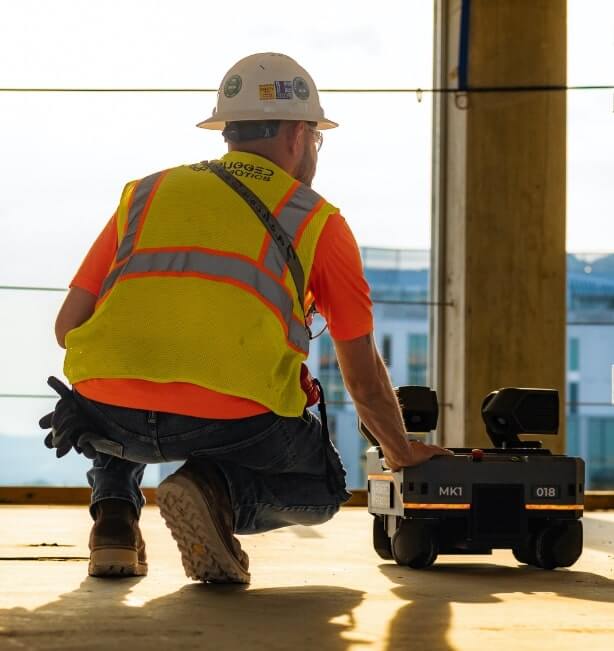
Note: “Layout robot” and “robotic total station” are not the same category of tool. This article compares robotic total stations — motorized surveying instruments made by Trimble, Leica, and Topcon — age of an autonomous layout robot is significant.
Quick Answer: A robotic total station is a motorized surveying instrument that lets one operator measure and mark individual points without a second person on the prism pole, though it still marks points one at a time. An autonomous layout robot drives itself across the floor, reads BIM files, and prints complete layouts, including lines, text, symbols, and curves, without manual point-shooting. For high-volume, multi-trade interior layout, the speed and labor advantage of an autonomous layout robot is significant.
Head-to-Head Comparison
| Robotic Total Station | Rugged Robotics Mark1 | |
| Operation | Human marks each point manually | Fully autonomous, robot prints, operator monitors |
| What it marks | Individual points | Lines, text, symbols, curves, full trade layouts |
| Speed | Point-by-point; faster than manual, still slow at scale | Hours for scope that takes a crew days with an RTS |
| Accuracy | Depends on operator skill, calibration, and field conditions | < 1/8″ (~2–3mm) |
| Labor | 1 skilled operator (vs. 2 for manual) | 1 operator managing the platform |
| Multi-trade | One trade at a time; re-setup required between trades | All trades in a single pass |
| BIM integration | Partial, requires CSV or point export | Full BIM/CAD integration (Revit, DWG, DXF, CSV) |
| Positioning | Total station / prism tracking | Passive target network, no total station needed |
| Best for | Spot checks, surveying, low-density layout | High-volume, multi-trade interior layout |
| Equipment overhead | Purchase/lease/maintain/train | Full-service, Rugged brings everything |
Both tools use the word “robotic.” Both have a place on commercial construction sites. But they solve fundamentally different problems, and using the wrong one for your project will cost you time, labor, or both.
The confusion around layout robot vs total station is understandable. “Robotic total station” and “layout robot” sound interchangeable to anyone outside the surveying and construction technology world. They are not. One is a smarter measuring instrument. The other is a fully autonomous printing system. Understanding the difference is increasingly important as autonomous layout technology moves from early-adopter territory to standard commercial practice.
Here’s exactly what each tool is, how they compare, and how to decide which approach is right for your scope.
What Is a Robotic Total Station?
A total station is a precision optical instrument used in construction and surveying to measure horizontal angles, vertical angles, and distances. It’s been the standard layout tool for commercial construction for decades.
A robotic total station (RTS) adds motorized tracking and remote control. Instead of requiring a two-person crew, one at the instrument and one with a prism pole, an RTS can track a single operator moving around the floor with a prism. The instrument follows automatically and relays measurements back to a data collector. One trained operator can do the work of two.
In practice, an RTS layout workflow looks like this: the operator holds a prism pole, walks to each point location, the instrument reads the position, and the operator marks the floor by hand, at each point, one at a time. The RTS makes this process faster and more manageable for a single person. It does not eliminate the manual work at each point. If you’re laying out 2,000 hanger locations, 2,000 individual measurements and marks are required.
Robotic total stations are manufactured by Trimble, Leica, Topcon, and others. They’re widely available, well understood, and deeply integrated into contractor workflows. They also require trained operators, calibration, and ongoing equipment maintenance, whether purchased or leased.
What Is an Autonomous Layout Robot?
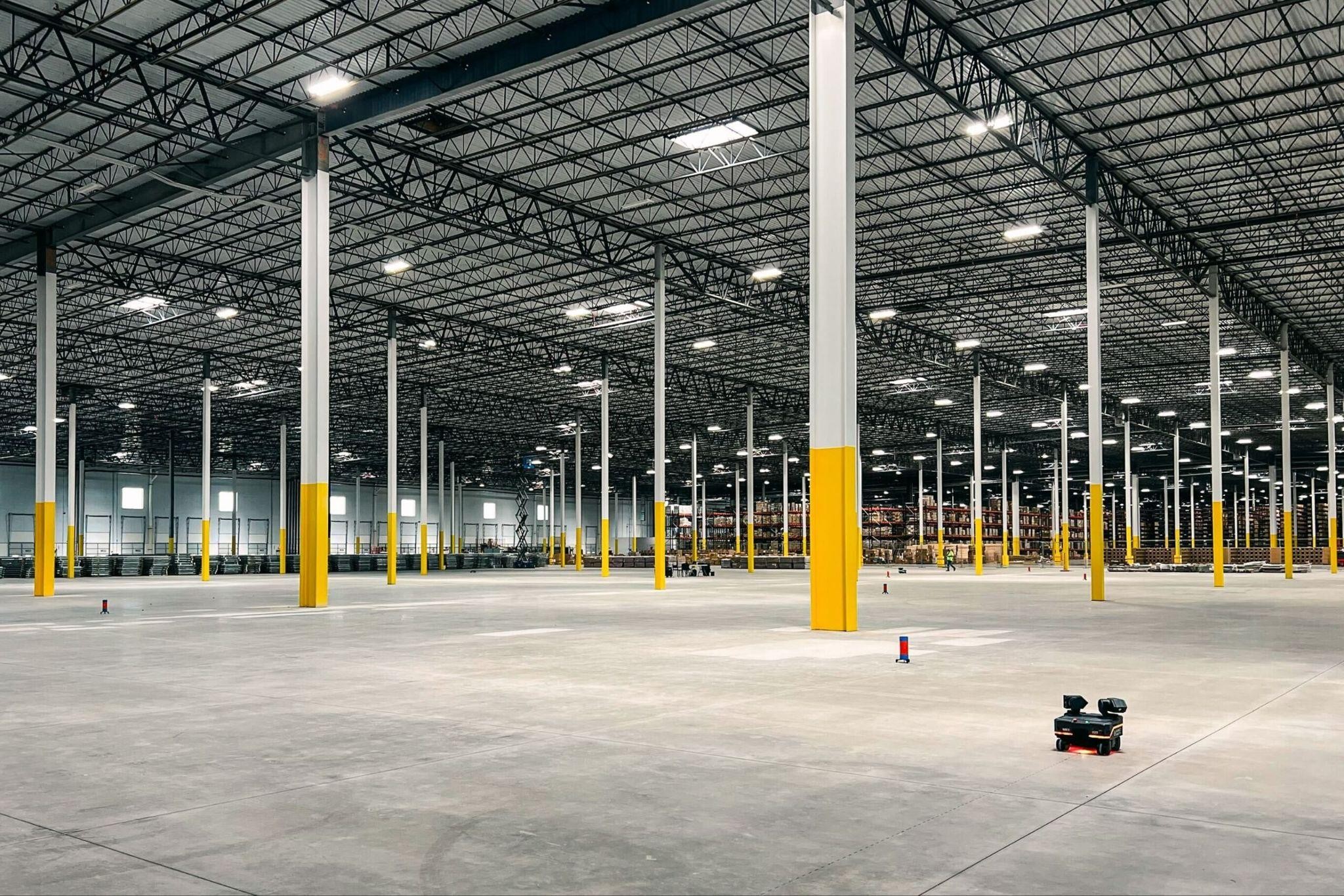
An autonomous layout robot is a different category of tool entirely. It is a self-driving ground-based machine that reads digital construction files, including Revit models, AutoCAD drawings, and CSV point exports, and prints complete layout markings directly onto the concrete slab: wall centerlines, MEP hanger points, ductwork paths, pipe sleeve locations, electrical rough-in, equipment pad footprints, and more.
The operator does not mark points manually. The robot drives itself systematically across the floor and does the printing. One operator monitors the process and performs quality checks, but the robot executes layout autonomously.
The output is also fundamentally different from what an RTS produces. An RTS marks individual points: dots on the slab. A layout robot prints full, hypervisible layouts: bold linework, multi-line text labels, symbols, curves, complex angles. Trade crews install directly from what the robot prints without re-measuring or re-interpreting drawings.
Rugged Robotics’ Mark1 is worth specific attention here: it doesn’t use a total station at all for positioning. Instead of relying on an RTS to track a prism on the robot, the Mark1 uses a network of passive targets set up around the floor. This gives it faster site setup, greater flexibility on complex or congested floors, and eliminates the dependency on total station equipment entirely, a meaningful operational advantage on busy commercial sites. Understanding how Rugged’s layout process works makes the comparison clearer.
One operator, one pass, every trade’s layout simultaneously: that’s the operational model for autonomous layout robots on commercial projects.
The accuracy gap is meaningful: Rugged’s Mark1 can typically deliver accuracy within 1/8 inch (approximately 2–3mm), while RTS accuracy in the field depends heavily on operator skill, calibration, and site conditions. Over a large floor with hundreds of hanger points, wall intersections, and structural embeds, that variability determines whether trades install cleanly or spend days correcting misalignment.
When to Use a Robotic Total Station
An RTS remains the right tool when:
Layout density is low. Spot-checking a handful of column centerlines or verifying control points doesn’t justify deploying a layout robot. An RTS is fast and efficient for low-count, discrete point work.
The work requires a licensed surveyor. Legal surveys, property boundary work, and certain structural milestone verifications require a licensed professional with a calibrated instrument. That’s RTS territory. Layout robots don’t change that.
You need flexible spot verification. Checking as-built conditions against design, verifying embed locations after a pour, confirming control before layout begins: these are RTS workflows that a layout robot doesn’t replace.
Project scope is small or single-trade. For a small tenant improvement or a low-density single-trade scope, an RTS can be cost-effective relative to mobilizing a full robotic layout service.
When to Use an Autonomous Layout Robot
A layout robot, and specifically a full-service model like Rugged Robotics, outperforms the RTS on:
High-density MEP layout. Data centers, hospitals, industrial facilities, commercial office towers, where hanger density is high and multiple trades need accurate layout simultaneously. The speed advantage compounds rapidly: what takes a two-person RTS crew a week can take Rugged hours on a dense, multi-trade commercial floor.
Multi-trade coordination on a single floor. Printing MEP, drywall, and structural embeds in one pass reduces trade sequencing conflicts and cuts down on the MEP-drywall mismatch that generates costly rework later in the project.
Schedule recovery. When a project is behind and layout needs to happen overnight or across multiple floors simultaneously, Rugged’s full-service delivery model compresses weeks of manual layout into days without adding headcount. Off-hours and overnight scheduling is available.
Rework reduction. Research from the Construction Industry Institute (CII) and the Navigant Construction Forum puts rework costs between 5% and 9% of total project cost on typical commercial builds, with indirect costs pushing the figure higher on complex projects, and a significant share traces to layout errors: compounding tolerances, misread drawings, and marks that were scuffed or shifted before trades could install from them. Direct BIM-to-slab output reduces most of those error sources at the root.
Automated and precision facilities. Data centers, automated warehouses, and semiconductor plants, where dense, coordinated MEP and structural precision are both non-negotiable. See Rugged’s full range of use cases by trade and project type for project-specific context.
How Rugged Robotics Fits In
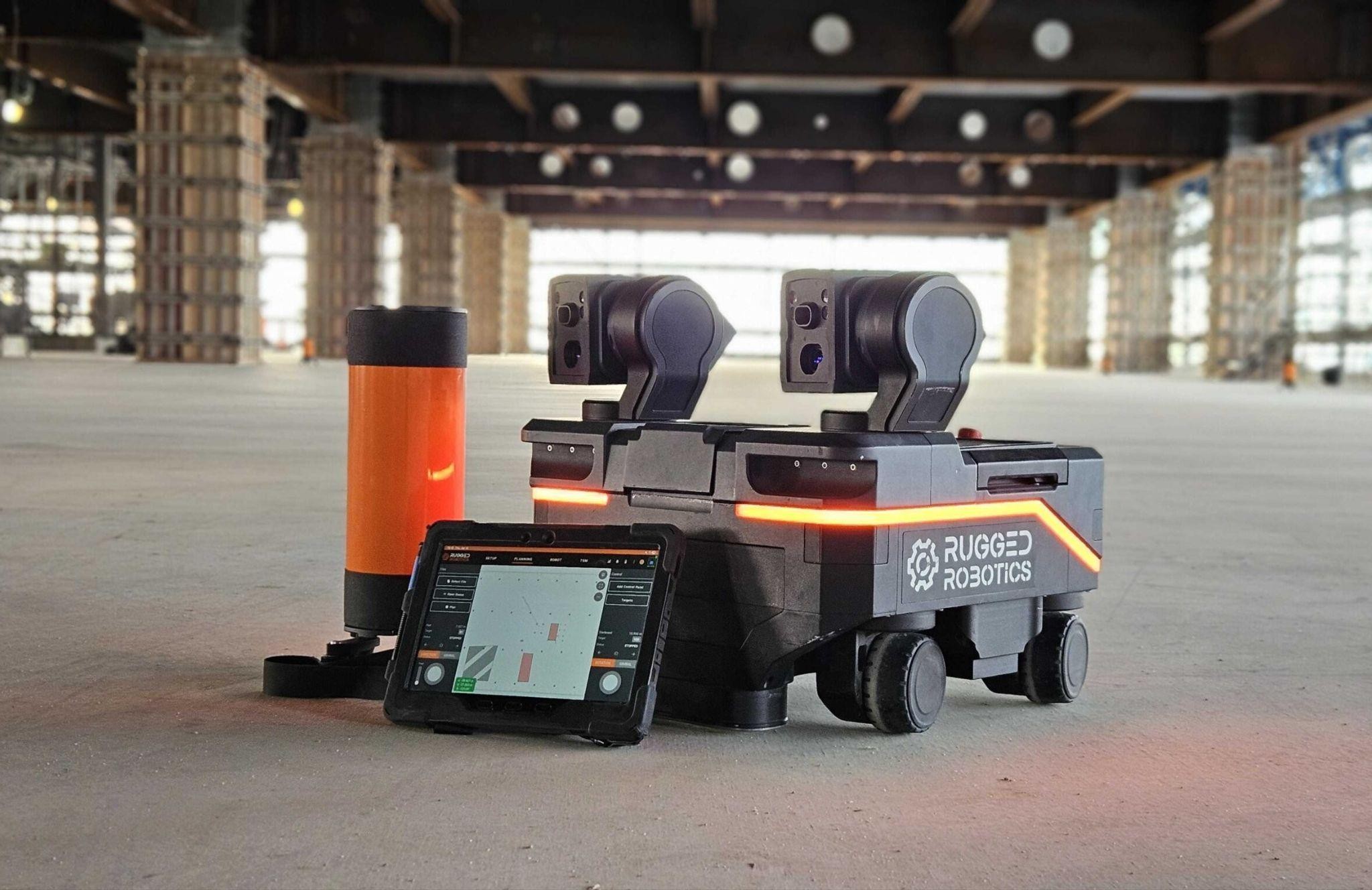
Rugged Robotics is a full-service automated layout platform. It’s not a robot you buy, lease, or train your crew to operate. Rugged’s team handles file prep, mobilization, site setup, and printing. Your superintendent coordinates timing; Rugged delivers the layout ready for trade installation.
The Mark1 robot can typically deliver accuracy within 1/8 inch using a network of passive targets, with no total station dependency. It accepts Revit, AutoCAD, and CSV files from your VDC team, prints all trade layers in a single pass, and tracks real-time completion as documentation for project closeout.
For more background on the technology and how it fits into a construction workflow, see What Is a Layout Robot in Construction?
Frequently Asked Questions
Is a layout robot the same as a robotic total station?
No. A robotic total station (RTS) is a surveying instrument that some layout platforms use as an external positioning reference — it still depends on a person walking out and marking each point in the field. A construction layout robot is a purpose-built, mobile field robot that translates a coordinated BIM/CAD model into printed layout — lines, outlines, bolt holes, labels, and more — directly on the slab or deck. They’re different categories of technology that solve different problems.
Can a layout robot replace a robotic total station entirely?
For interior production layout on commercial floors, a layout robot can handle the core layout scope faster and more consistently than an RTS, with less manual measuring. However, RTS instruments remain the right tool for licensed surveying work, boundary determination, and establishing or verifying site control. Most large commercial projects benefit from both: an RTS (or comparable site-control method) for control setup and verification, a layout robot for production layout.
How accurate is a layout robot compared to a robotic total station?
Layout robots like Rugged’s can typically deliver accuracy within 1/8 inch (approximately 2–3mm) relative to the project’s verified control network. Robotic total station accuracy in the field varies with operator skill, instrument calibration, and site conditions. The accuracy advantage matters most at scale, on dense commercial floors where tolerance stackup compounds across hundreds of points and leads to coordination problems and rework downstream.
Do layout robots use total stations?
Some do; Rugged doesn’t. Certain layout robot systems use a robotic total station as a positioning reference: the RTS tracks a prism on the robot to determine its location on the floor. Rugged’s approach uses onboard localization and site references instead, which eliminates the dependency on total station equipment and gives it faster, more flexible site setup.
Which is faster, a robotic total station or an autonomous layout robot?
For production interior layout, automated layout has a clear speed advantage: it compresses work that would otherwise take multiple trade-by-trade passes into one faster, continuous printing pass, with all trade layers reflected and no re-setup between trades. For low-count spot verification, an RTS can be faster because there’s no mobilization overhead.
What is the cost difference between a robotic total station and a layout robot service?
An RTS involves capital equipment cost (purchase or lease), operator training, calibration, and ongoing maintenance. Rugged’s full-service model removes that equipment overhead — instead of buying or maintaining a tool, you pay for the layout scope delivered on your project, without adding training burden or in-house equipment management. See how Rugged calculates pricing or request a project-specific quote to run a direct comparison against your current layout costs.
Ready to See the Difference on Your Project?
Rugged handles the full process, including file prep, mobilization, and printing, so your crew can focus on installation. Start with a pilot project and see the speed and accuracy advantage firsthand.