Automated layout is no longer a future idea. It is working on jobsites today, and the leaders building it agree the real competitor is still the chalk line.
That was the clearest message from Layout Mania, a founder debate hosted by Bricks & Bytes. Rugged Robotics founder and CEO Derrick Morse joined Tessa Lau of Dusty Robotics, William St-Pierre of Mechasys, and Tomer Elran of LIGHTYX for eight fast rounds with 60-second answers.
A big thank-you to Owen and the Bricks & Bytes team for putting it together, and to Christian Reed, founder and CEO of REEKON Tools, who moderated with sharp, practical questions. As Christian put it, getting four founders in one room is hard. Getting four founders who are this generous with each other is rarer still.
Here are the five takeaways we think every contractor should hear.
1. The biggest competitor is still chalk and tape
Tessa Lau opened round one with the line of the day: “Pretty much our biggest competitor is chalk lines and measuring tape.” She noted the chalk line goes back thousands of years, to the builders of the pyramids, and is still how most floors get laid out.
Every founder agreed. William said most Mechasys customers come from chalk line, tape, and total station workflows. Tomer said more than 80% of LIGHTYX conversations are a move from manual to digital, not a switch between technologies.
That consensus matters for contractors. The question is not which automated tool “wins.” It is whether your project is still paying for manual layout, with the rework and delays that come with it.
2. Printing and projection are partners, not rivals
The debate was billed as robots vs. laser projection. The founders showed it is really robots and laser projection.
William made a strong case for projection’s flexibility. It works when a slab isn’t clear and lets crews move to another spot when materials land on site. Tomer explained that some LIGHTYX customers skip marking entirely and drill straight onto the projection on ceilings.
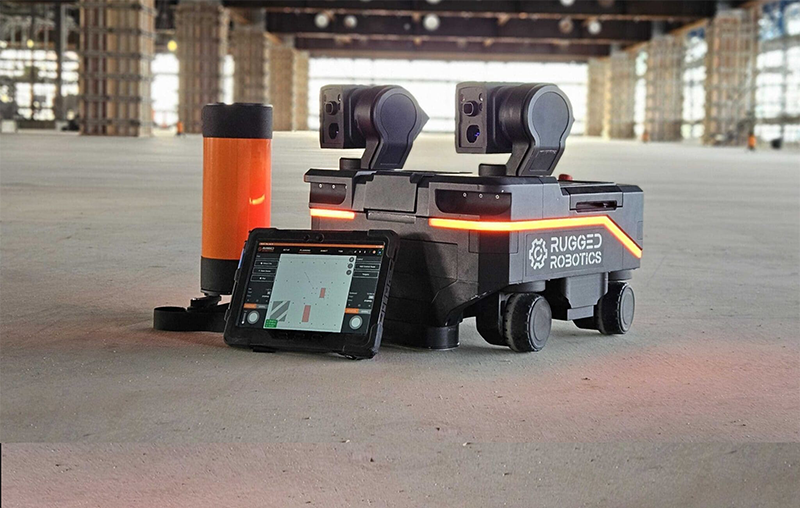
Derrick explained why Rugged marks the floor. Our projects run from about 20,000 sq ft floor plates to more than 1 million sq ft. Permanent floor marks let large installation crews spread out fast along corridors. MEP trades already laser-plumb up from the floor, so detailed floor layout lets them hang runs of 100 to 300 ft quickly.
Tessa shared that one Dusty customer runs Dusty and LIGHTYX on the same job, using printed floor layout as ground truth and projecting from it. That’s a picture of where the market is heading: the right tools for each surface and each phase.
3. Layout has to work in real site conditions
Accuracy came up in every round. Dusty’s answer is a Hexagon laser tracker paired with its robot, which Derrick credited for getting Dusty to market fast. Rugged took the harder road of building accuracy into a self-contained platform.
That choice comes from the field. For Derrick, the accuracy that counts is the accuracy that holds up on a real site, not just on a spec sheet. That’s why Rugged measures every layout against verified site control and makes the system easy enough to deploy anywhere. “Our north star for all of our design decisions was ease of use,” he said.
That is why site conditions came up so often. An audience question asked about slab deflection, thermal expansion, and error accumulation. Derrick pointed to two things Rugged built after learning in the field that a layout can be “maybe too perfect”:
- Control verification. Before printing, the robot checks the site control and flags issues, such as points shifted by heat or set loosely.
- Tracked field adjustments. When a feature has to move, the change is recorded so the team can document it in an RFI.
William raised the same point from the projection side. He described how undocumented field changes, decided by a layout worker in the moment, are one of the industry’s quiet risks. Tomer and Tessa described scanning and reality-capture workflows that adjust layout to as-built conditions. On this, the whole panel agreed: flexible, documented layout beats perfect layout on a perfect drawing.
4. The work starts before any robot moves
Automated layout is only as good as the data behind it. D
errick said one early lesson was how heavy the burden of cleaning and processing files can be.
So Rugged is pushing in both directions:
- Upstream: accepting a wider range of file formats, design quality, and levels of detail, so contractors don’t have to be the most sophisticated VDC shops in the world to benefit.
- Downstream: carrying more detail to the slab, down to panel and circuit numbers for every receptacle, so electricians know exactly where to drop wire.
Other panelists see it the same way. Tomer said LIGHTYX works from BIM, DWG, CAD drawings, and even PDFs, so contractors can start with the files they have. Tessa explained why it matters: automated layout is not just labor replacement. Done right, it lifts “the productivity of every single trade on that site.”
But that only happens when the data going in is right, and that work is where Rugged’s full-service model starts. The customer’s VDC team provides the models in whatever formats they exist in. Rugged assists with coordination, prepares the layout, mobilizes the field capacity the schedule requires, verifies site control, and delivers installer-ready information directly on the slab.
5. Adoption is change management, and the time is now
The adoption round was full of hard-won lessons, off
ered candidly:
- William: adoption is the manufacturer’s responsibility, driven by workflow fit, customer success, and support contractors can trust.
- Tomer: ease of use, fast training, and fitting existing workflows, so crews actually enjoy the tool.
- Tessa: a flywheel that starts with proving ROI on one project and grows into an enterprise standard.
- Derrick: “We have to approach every engagement as an organizational change management initiative,” helping stakeholders move from price to value.
Derrick also shared a story from a GC office with a sign on the wall reading “Trust the process.” His view is that change needs more trust in people: hire great people, give them autonomy, and let them try new tools. Tomer and Tessa both pointed to a related barrier. Large contractors are fragmented, and projects run for years, so a win on one job can take time to spread.
The founders also struck a hopeful note on the workforce. Tessa described union training programs for automated layout and the new layout technician roles customers are creating. William noted the technology can help draw younger workers into the trades.
Derrick’s closing message sums it up: “Automated layout is here. It’s here today. It’s working.” If you’re not seriously looking at it, your competitors are.
Watch the full debate
Thanks again to Bricks & Bytes, Owen, and Christian Reed for a great conversation, and to Tessa, William, and Tomer for their candor and generosity. Moving one of the world’s largest industries takes all of us. As William said, “we’re all working together” to bring better layout to construction.
Ready to take layout off your team’s plate? Rugged is a full-service layout provider. We prep the files, verify control, and deliver installer-ready layout on the slab, on your schedule. See how it works or start a pilot.
Related reading: